Priced Out by Design: How Post-Brexit Inflation Has Fallen Hardest on Britain's Working Poor
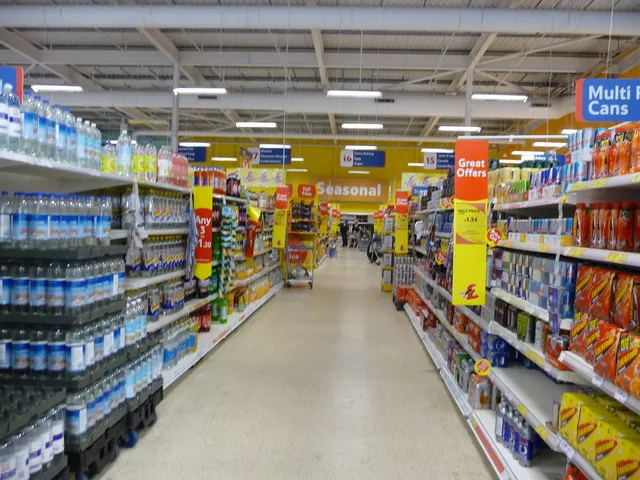
Photo: Lewis Clarke, CC BY-SA 2.0, via Wikimedia Commons
There is a particular cruelty to inflation that targets the essentials. When the price of a luxury rises, the affluent may grumble and adjust. When the cost of bread, cooking oil, or a unit of electricity climbs, those on the lowest incomes have nowhere to turn. Since Britain's formal departure from the European Union's single market and customs union at the close of 2020, a pattern has emerged in the data that deserves far more political attention than it has received: the inflationary consequences of Brexit have not been distributed equally across the social spectrum. They have, in measurable and consistent ways, pressed down most heavily on working-class Britain.
The Essentials Under Pressure
The mechanism is not difficult to trace. Brexit introduced new layers of friction into UK supply chains — customs declarations, sanitary and phytosanitary checks, rules-of-origin requirements, and the sheer administrative weight of trading across a newly erected regulatory border. Each of these frictions carries a cost, and those costs are passed on. The question is not whether prices rose, but which prices rose most sharply, and who buys those goods.
The answer, borne out by successive analyses of supermarket data from the British Retail Consortium and independent academic research, is that food staples — precisely the goods that constitute the largest share of spending for lower-income households — experienced among the steepest post-Brexit price increases. Fresh produce sourced from EU member states, processed foods reliant on European ingredients, and chilled goods subject to new border inspection requirements all saw notable cost escalation between 2021 and 2023.
The UK in a Changing Europe think tank estimated that by the end of 2023, Brexit had added between £210 and £250 per year to the average household food bill. That figure, already painful in isolation, understates the impact on the poorest households. A family spending 20 per cent of its net income on food absorbs that increase very differently from one spending 8 per cent. The arithmetic of poverty means the same price rise represents a fundamentally different burden depending on where you stand in the income distribution.
Energy, Trade, and the Compound Effect
Food is only part of the story. Britain's energy crisis, which intensified dramatically following Russia's invasion of Ukraine in 2022, was shaped in part by the country's post-Brexit position outside the EU's internal energy market. Interconnectors with the European grid remain operational, but Britain's reduced participation in cross-border energy trading mechanisms left it more exposed and less agile in managing price volatility. The result was energy bills that climbed to extraordinary heights — and again, the impact was concentrated at the bottom of the income ladder.
Low-income households in Britain spend a higher proportion of their budgets on energy than their wealthier counterparts. They are more likely to live in poorly insulated homes — a structural inequity that predates Brexit but was sharpened by it. Government support schemes such as the Energy Price Guarantee provided some relief, but they were blunt instruments that did not fully compensate for the compound effect of rising food, energy, and transport costs hitting simultaneously.
This convergence of pressures is sometimes described simply as a 'cost of living crisis,' a phrase that risks obscuring its uneven character. It was not a crisis experienced uniformly. For households in the upper income quintiles, savings accumulated during the pandemic provided a buffer; rising asset values — particularly in property — offered insulation. For households in the bottom two quintiles, there was no such cushion.
Regional Dimensions: Where the Burden Landed
The class dimension of post-Brexit inflation has a clear geographic expression. The regions that voted most heavily for Leave in 2016 — post-industrial towns in the Midlands and the North, coastal communities in Wales and the North East, former mining areas across Yorkshire — are, by and large, the same regions where household incomes are lowest and where the inflationary burden has been felt most acutely.
This is not to suggest that Leave voters were naive about the potential economic consequences of their choice. The 2016 referendum was decided by a complex interplay of identity, sovereignty, and accumulated grievance against an establishment that had long neglected these communities. But the economic trajectory since departure has done little to address those grievances, and in several measurable respects has deepened them.
Wealthier regions, meanwhile, have fared differently. London's financial services sector, reconfigured but resilient, has adapted to post-Brexit realities. The professional classes have, in many cases, absorbed price rises through higher earnings or asset appreciation. The promised 'Brexit dividend' — the notion that regulatory freedom and new trade agreements would generate broad-based prosperity — has yet to materialise in any form discernible to a family managing a weekly food budget in Sunderland or Stoke.
The Political Economy of Invisible Costs
What makes this dynamic particularly difficult to address is its invisibility. A tariff imposed at a border is a legible political act; it can be debated, reversed, or renegotiated. But the inflationary consequences of regulatory divergence, supply chain disruption, and reduced market access accumulate gradually, distributed across millions of individual transactions. They do not appear on any government statement as a line item. They simply materialise in the weekly shop, the energy direct debit, the cost of a school uniform or a birthday present.
This invisibility has served a political purpose, whether or not that purpose was deliberately designed. Successive governments have been able to attribute price rises to global factors — the pandemic, the Ukraine war, commodity markets — without being held specifically accountable for the Brexit contribution. The Office for Budget Responsibility has estimated that Brexit will reduce long-run UK productivity by around four per cent relative to the counterfactual of remaining in the EU. That is a structural drag, not a headline event, and structural drags do not generate the kind of political accountability that a single, visible policy failure might.
What an Honest Reckoning Requires
None of this is to argue that Brexit's consequences are exclusively negative, or that the decision to leave was made without legitimate reasoning. It is to argue that an honest accounting of those consequences must engage seriously with the distributional question: who has paid, and who has been insulated from payment?
The evidence, assembled patiently across supermarket price data, energy cost analyses, and household expenditure surveys, points in one direction. The inflationary costs associated with Britain's post-Brexit trading arrangements have fallen disproportionately on lower-income households, in lower-income regions, many of which voted enthusiastically for the change they were promised.
For Britain to move forward with any coherence — regardless of one's view on the original decision — that reality must be named. The invisible tariff is real. It has a postcode. It has an income bracket. And until policymakers are willing to acknowledge its shape, the communities bearing its weight will continue to do so largely in silence.